Production History


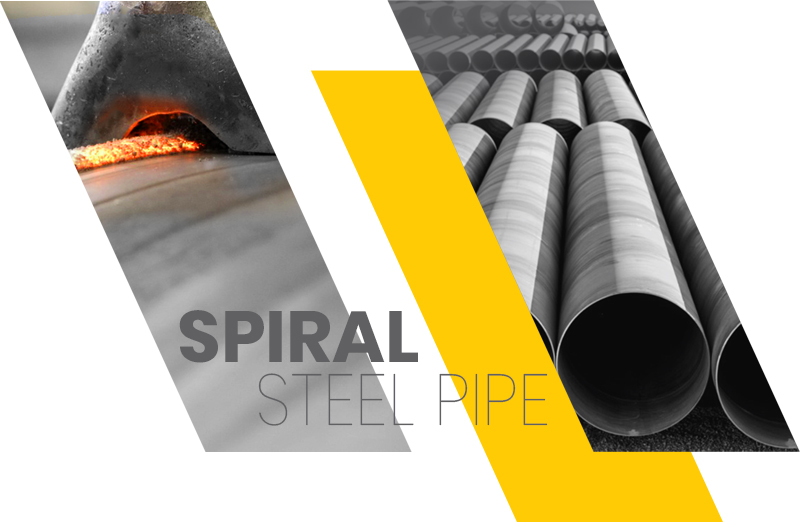
Spiral pipes were first produced in 1877. So far, manufacturing process of spiral pipes has been developing, so that it is now economically possible to manufacture large-diameter spiral pipes. The pipes are utilized to transmit fluids such as water, gas, and oil, as well as in fundamental industries and structural pipes. To date, many efforts have been made to increase the production of such pipes. This is the most effective method of production increase, by increased welding speed. Through the process of spiral pipe production, the shaped pipe is immediately submerged arc welded, both internally and externally. These high-quality pipes have successfully been used for high-pressure systems

Advantages of Spiral welded pipes

  • • They can be produced in an extensive range of diameter and thickness.
  • • No need to operations such as calibration to directly reach the final shape with high precision, so that welding and installing at the sites is easier.
  • • Stress distribution in spiral steel pipes is more even than straight-welded pipes. In other words, energy distribution is more even around the welded point and more homogenous mechanical properties are achieved; they, consequently, become more durable against breakage.
  • • Spiral steel pipes are more resistant to crack growth.
  • • Due to Bandage Effect, spiral pipes are more resistant to breakage.
  • • Welded point in spiral steel pipes is more durable than that in straight seam-welded pipes to loop stress.

Utilization of Spiral Steel Pipes

Oil, Gaz, Petrolium Industry

API 5L & IPS-M-PI-190 steel pipes in oil, gas, and petrochemical industry

Water and Fluid Transmission

Spiral steel pipes are highly applicable for transmission pipelines and distribution network of water supply projects. These types of steel pipeline are produced under AWWA C200 standard.

Steel pipes for piling of columns

Steel pipes for piling of columns and foundations in accordance with ASTM A252 standard

construction and industry

Steel pipes are used in industry and construction for steel structures. These types of steel pipes are often produced by construction-grade material. Pressure vessels are manufactured by A516 material

A STEEL COMPANIAN

keivan-javid pipe protection

Internal and External Coating Of Steel Pipes

Every year, substantial costs are incurred worldwide for the maintenance of metal structures and their protection against corrosion.

One of these areas is the transmission lines for oil, gas, and water. The most reliable and cost-effective way to protect the pipes is to prevent the intrusion of corrosive factors such as moisture, oxygen, and other corrosive agents. This can be achieved by applying a coating that is impermeable to these factors.

Corrosion protection is not limited to the external surface of steel pipes. In cases where the fluid inside the steel pipe is corrosive or contains suspended solids, it can lead to chemical or physical (mechanical) corrosion inside the steel pipe. Therefore, protecting the inner surface of the pipe against corrosion also becomes particularly important.

External Coating 

  • Single-Layer Fusion-Bonded Epoxy Coating (FBE)
  • Two-Layer Fusion-Bonded Epoxy Coating (DL_FBE)
  • Oil-Based Coating System (Bitumen Enamel)
  • Aromatic Polyurethane Two-Component Coating
  • Liquid Coatings for Corrosion Protection of Above-Ground Steel Pipes (Anti-UV)

Internal Lining

  • Solvent-Free Liquid Epoxy Lining
  • Internal coating of cement sand mortar
  • Internal antistatic epoxy coating
  • Epoxy coating, flow facilitation
  • Single and multi-layer coatings based on epoxy resins